§ Journal · May 28, 2026
Pitch, Gauge, Drive Links Explained — How to Order the Right Chain
The 3 numbers that must match. Show how to read them from old chain and bar stamp. Link to our matching tool / shop filter.
Published · Last updated:
Pitch, Gauge, Drive Links Explained — How to Order the Right Chain
Ordering a replacement chainsaw chain should be simple, but three small numbers make all the difference: pitch, gauge, and drive-link count. If even one is wrong, the chain may not fit your bar or saw correctly.
For homeowners replacing a worn chain on a battery or gas chainsaw, these are the three specs that must match. Bar length matters too, but bar length alone is not enough to guarantee fitment. Two 16-inch bars can use different chain sizes depending on the saw, bar slot width, and sprocket setup.
In this guide, we’ll explain what each spec means, how to find it on your old chain or bar stamp, and how to use that information to order an exact-fit replacement from our [matching tool / shop filter].
Why bar length alone is not enough
A common mistake is shopping by bar length only: “I need a 14-inch chain” or “my saw has an 18-inch bar.” That’s a useful starting point, but it doesn’t identify the exact chain.
To order the right replacement, you need:
- Pitch
- Gauge
- Drive-link count
These determine whether the chain will properly engage the drive sprocket, fit the guide bar groove, and wrap the bar at the correct length.
For example, a 16-inch bar might use:
- 3/8” low profile, .043 gauge, 56 drive links
- 3/8” low profile, .050 gauge, 56 drive links
- .325 pitch, .050 gauge, 66 drive links
All are “16-inch chains,” but they are not interchangeable.
Quick definitions
- Pitch: the size/spacing of the chain links
- Gauge: the thickness of the drive links that fit into the bar groove
- Drive-link count: the number of drive links on the loop
If you match all three, you’ll usually get the correct chain.
Pitch vs. gauge — what each one does
Pitch and gauge are often confused because both are chain sizing specs, but they describe different parts of fitment.
Pitch
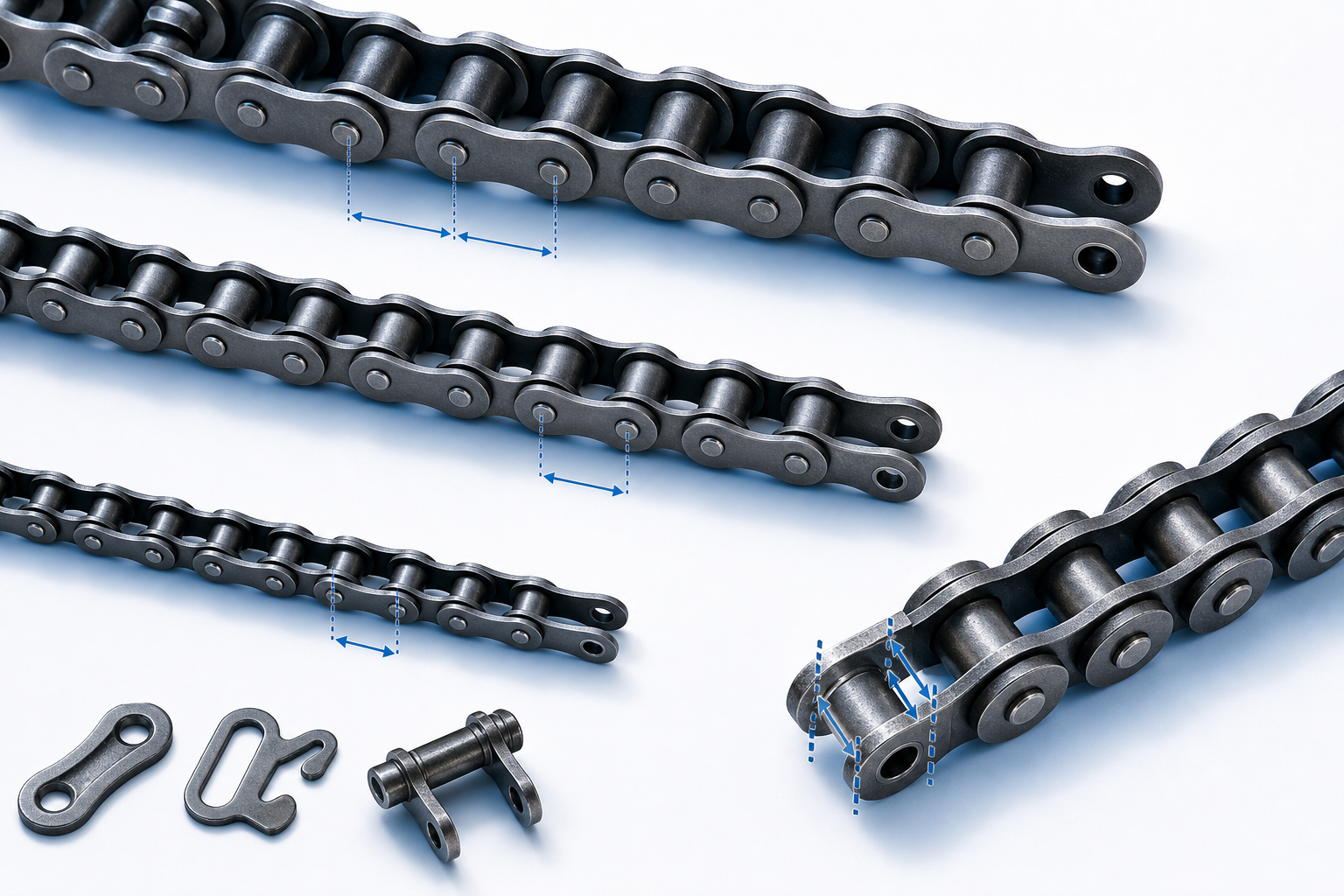
Pitch refers to the spacing between chain rivets. It must match the saw’s drive sprocket and bar nose sprocket.
Common homeowner chain pitches include:
- 1/4”
- .325”
- 3/8” low profile
- 3/8”
- .404” is less common for homeowner saws and more typical in larger professional setups
Battery chainsaws and smaller gas saws often use:
- 1/4” pitch on compact pole saws and mini saws
- 3/8” low profile on many 10”, 12”, 14”, 16”, and 18” homeowner saws
- .325” pitch on some mid-size gas chainsaws
Gauge
Gauge is the thickness of the drive link—the part that sits in the guide bar groove.
Common gauges include:
- .043”
- .050”
- .058”
- .063”
For most homeowner battery and gas saws, the most common are:
- .043 gauge: often found on lighter-duty battery saws and narrow-kerf setups
- .050 gauge: very common across homeowner and prosumer models
If the gauge is too thick, the chain won’t fit into the bar groove. If it’s too thin, it may sit loosely and cut poorly.
Comparing typical homeowner setups
Lightweight battery saws
Often use:
- 3/8” low profile pitch
- .043 gauge
- Lower drive-link counts depending on bar length
These chains are designed to reduce load on smaller motors and maximize runtime.
Standard homeowner gas saws
Often use:
- 3/8” low profile or .325 pitch
- .050 gauge
- Moderate drive-link counts
These are common on 14” to 18” saws used for storm cleanup, limbing, and firewood.
Higher-output gas saws
May use:
- .325 or 3/8” pitch
- .050”, .058”, or .063 gauge
These setups are more common when bars and saws step up in size and power.
Drive-link count — the number that completes the fit
If pitch and gauge describe the chain’s size, drive-link count determines the loop length.
This is the spec many buyers miss.
What is a drive link?
Drive links are the lower tabs on the chain that sit in the bar groove and engage the sprocket. The total number of these links determines whether the chain is the correct length for your specific bar.
Two chains can share the same:
- pitch
- gauge
- bar length
…but still require different drive-link counts depending on bar design and saw model.
Common examples by bar length
These examples are typical, not universal:
10-inch bars
Often found with:
- 3/8” low profile, .043, 40 DL
- 3/8” low profile, .050, 40 DL
12-inch bars
Often found with:
- 3/8” low profile, .043, 45 DL
- 3/8” low profile, .050, 45 DL
14-inch bars
Often found with:
- 3/8” low profile, .043, 52 DL
- 3/8” low profile, .050, 52 DL
16-inch bars
Often found with:
- 3/8” low profile, .043, 56 DL
- 3/8” low profile, .050, 56 DL
- .325, .050, 66 DL
18-inch bars
Often found with:
- 3/8” low profile, .050, 62 DL
- .325, .050, 72 DL
Again, these are common combinations, not guarantees. The right chain is always the one that matches your actual bar and saw specs.
How to find pitch, gauge, and drive links on your saw
The easiest way to order correctly is to read the specs from the bar stamp or from the old chain.
1. Check the guide bar stamp
Most chainsaw bars have sizing information stamped or printed near the mounting end. Look for a sequence that includes:
- bar length
- pitch
- gauge
- drive-link count
A bar might show something like:
- 16” / 3/8 LP / .050 / 56DL
- 18” / .325 / .050 / 72DL
This tells you exactly what to order.
2. Read markings on the old chain
Some replacement chains have identifying numbers stamped on the drive links. These numbers can often be cross-referenced to chain specs.
Keep in mind:
- Not every chain is easy to decode by eye
- Stamped codes vary by manufacturer
- If the chain is heavily worn, markings may be hard to read
If the old chain is original and known to be correct, counting drive links and confirming pitch/gauge is a reliable method.
3. Count the drive links manually
If the bar stamp is unreadable, count the drive links on the old chain.
Tips:
- Lay the chain out on a bench
- Count only the drive links, not cutters
- Mark your starting point with a paint pen or tape so you don’t lose your place
4. Use the owner’s manual or model lookup
Many manuals list the original chain spec. If not, use your saw’s model number with our [matching tool / shop filter] to narrow down exact-fit options.
Comparing replacement chain options by spec and price tier
Once you know your numbers, the next question is which chain quality level to buy. Most homeowners are choosing between value-focused replacement chains and longer-wearing premium options.
Budget/value chains
Best for:
- occasional users
- backup chains
- light storm cleanup
- saws used a few times per season
What to expect:
- lower upfront cost
- suitable fit when specs match exactly
- good value for homeowners maintaining a small property
Typical pricing:
- 10” to 14” chains: budget tier often starts around $12–$18
- 16” to 18” chains: often $15–$22
Mid-range chains
Best for:
- regular homeowner use
- firewood cutting
- users who want a better balance of sharpness retention and price
What to expect:
- improved durability over entry-level options
- smoother cutting on common homeowner saws
- strong value for battery and gas models alike
Typical pricing:
- 12” to 16” chains: often $18–$28
- 18” chains: often $22–$32
Premium chains
Best for:
- frequent cutting
- larger properties
- users who want the best edge life and consistency
What to expect:
- better steel, grind consistency, and wear life
- worth considering if you keep multiple sharpened loops on hand
- especially useful for higher-output gas saws
Typical pricing:
- often $25–$40+ depending on size and brand
Our picks
The right recommendation depends on matching pitch, gauge, drive links, and bar length first. From there, these are the types of products we recommend shopping in our catalog:
Best for most battery saws
Choose an exact-fit 3/8” low profile chain in .043 gauge matched to your bar length and drive-link count.
Common fitments include:
- 10” 3/8 LP .043 40DL
- 12” 3/8 LP .043 45DL
- 14” 3/8 LP .043 52DL
- 16” 3/8 LP .043 56DL
Why we like them:
- ideal for many cordless homeowner saws
- lower cutting resistance
- widely used on compact, narrow-kerf setups
Typical price tier:
- budget to mid-range
Best for common homeowner gas saws
Look for exact-fit 3/8” low profile or .325 pitch chains in .050 gauge.
Common fitments include:
- 14” 3/8 LP .050 52DL
- 16” 3/8 LP .050 56DL
- 16” .325 .050 66DL
- 18” 3/8 LP .050 62DL
- 18” .325 .050 72DL
Why we like them:
- broad compatibility across many gas models
- easy to find sharpening support and replacements
- good mix of cutting performance and durability
Typical price tier:
- mid-range
Best value: buy two matching loops
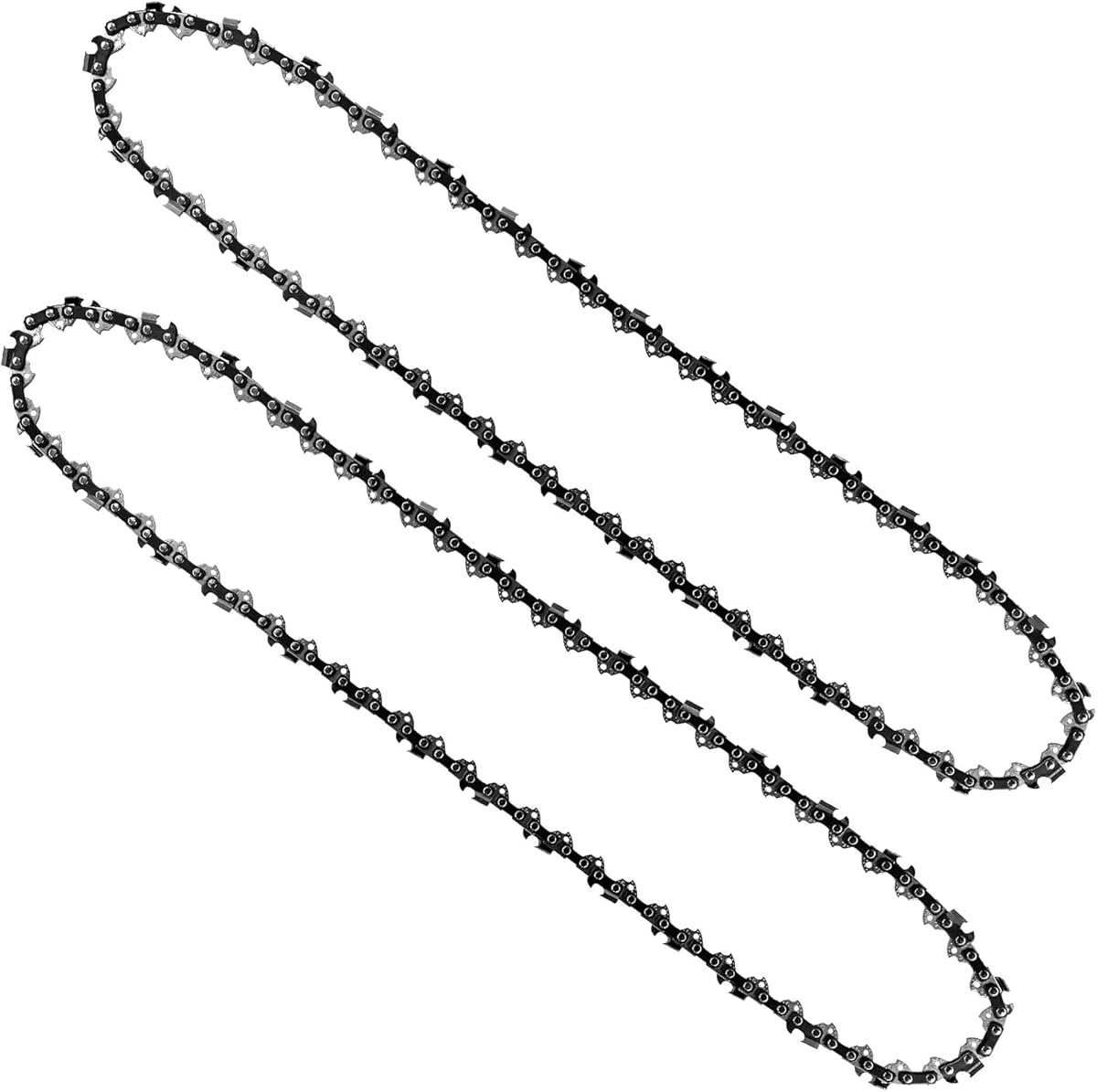
If you cut regularly, a 2-pack of the exact same chain spec is often the best value in the catalog.
Why:
- one chain can be in use while the other is sharpened or ready as backup
- usually lowers cost per loop
- practical for storm cleanup and weekend firewood cutting
Best premium option
For heavy homeowner use, choose a premium exact-fit loop in your required pitch, gauge, and drive-link count rather than upsizing bar length or switching specs.
Why:
- preserves proper saw fitment
- improves consistency and chain life
- better investment than buying the wrong “close enough” chain
To find the right one fast, use our [matching tool / shop filter] and enter either:
- your chainsaw model, or
- your chain specs: pitch, gauge, drive links, and bar length
FAQ
Can I replace my chain using only bar length?
No. Bar length alone is not enough. You also need pitch, gauge, and drive-link count.
Where do I find chain specs on the bar?
Usually near the base of the guide bar, stamped or printed on one side. Look for values such as:
- 3/8 LP
- .050
- 56DL
What does “DL” mean?
DL means drive links. It is the total number of drive links in the chain loop.
Are 3/8 and 3/8 low profile the same?
No. They are not always interchangeable. 3/8 low profile is a specific homeowner/light-duty chain format and should be matched exactly to your bar and saw setup.
Can I use a .050 gauge chain on a .043 bar?
No. The gauge must match exactly. A .050 chain is thicker than a .043 bar groove and will not fit correctly.
What if my old chain is missing or the bar stamp is worn off?
Use your saw model number with our [matching tool / shop filter]. If needed, check the owner’s manual for the original chain spec.
Is a more expensive chain always better?
Not always. For occasional homeowners, a value or mid-range exact-fit chain is often the best buy. Premium chains make more sense for frequent cutting and users who want longer wear.
Should I keep more than one chain?
Yes. Keeping a spare matched chain is smart, especially for homeowners cutting dirty wood, storm debris, or firewood.
If you’re ready to order, start with your three numbers—pitch, gauge, and drive links—then use our [matching tool / shop filter] to find the exact replacement chain for your saw.

Find the right part on Amazon
Check price, stock and fitment — ships direct from Amazon.
§ Parts