§ Journal · May 28, 2026
Best Replacement Chains for Battery Chainsaws — Budget Picks
Battery saws (DeWalt, Ryobi, Greenworks, EGO) use specific low-kickback chains. Compare aftermarket options by price and quality.
Published · Last updated:
Best Replacement Chains for Battery Chainsaws — Budget Picks
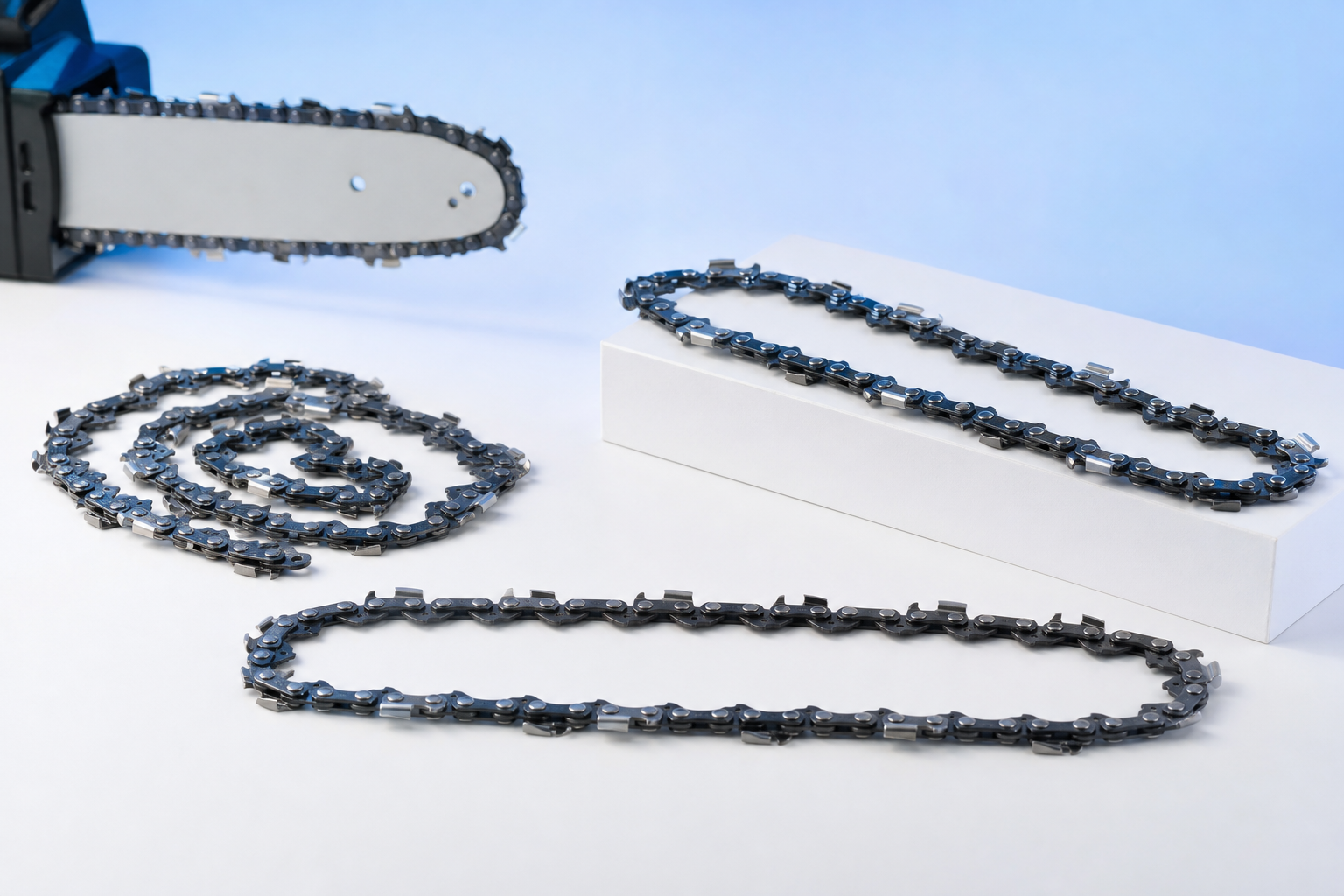
Battery chainsaws have made yard work simpler, quieter, and less intimidating for homeowners. But when it’s time to replace the chain, fitment matters more than brand loyalty. Most cordless saws from DeWalt, Ryobi, Greenworks, and EGO use low-kickback, narrow-kerf chains designed to reduce load on the motor and extend runtime. That means you can’t always swap in a generic chain just because the bar length matches.
The right replacement chain needs to match four specs exactly:
- Bar length — commonly 10”, 12”, 14”, 16”, or 18”
- Pitch — often 3/8” low profile on battery saws
- Gauge — typically .043” or .050”
- Drive-link count — varies by saw and bar combination
If one of those is wrong, the chain may not tension correctly, may not run safely, or may not fit at all. For homeowners shopping on a budget, the good news is there are strong aftermarket options that cost less than OEM while still delivering clean cutting and low vibration.
Why battery chainsaws need exact-match low-kickback chains
Cordless chainsaws are usually tuned around efficient cutting rather than raw chain speed. That’s why many manufacturers pair them with semi-chisel or chamfer-chisel low-profile chains and, in many cases, narrow-kerf cutters. Narrow-kerf designs remove less wood per pass, helping a battery saw cut faster with less strain.
A few common fitment examples:
- DeWalt 12” and 16” cordless saws often use 3/8” low profile pitch
- Ryobi 10”–14” models commonly use 3/8” low profile in either .043” or .050” gauge
- Greenworks consumer saws frequently use .043” narrow-kerf setups
- EGO 14” and 16” saws are often matched with efficient low-kickback chains for longer runtime
The biggest mistake buyers make is shopping only by bar length. A 14-inch chain is not automatically interchangeable with every 14-inch battery saw. For example, one 14” saw may need 3/8” LP, .043”, 52 drive links, while another needs 3/8” LP, .050”, 52 drive links. Same length, different chain.
For budget-minded buyers, aftermarket chain makers usually fall into three pricing tiers:
- Value tier: lowest upfront cost, decent for occasional pruning and storm cleanup
- Mid-tier aftermarket: better cutter consistency, improved edge retention, usually best value
- Premium/OEM-equivalent: smoother cutting and longer life, but not always necessary for light homeowner use
Budget vs mid-tier aftermarket chains
If you use your battery chainsaw a few weekends a year, a value-priced replacement chain can make sense. These chains are usually sold in singles or multipacks and are attractive for light-duty cutting. You’ll often see common battery-saw specs like:
- 3/8” low profile, .043”, 45 DL
- 3/8” low profile, .043”, 52 DL
- 3/8” low profile, .050”, 56 DL
- 3/8” low profile, .050”, 62 DL
Value-tier chains
These are usually the cheapest aftermarket options and can work fine for:
- occasional limb cleanup
- small-diameter firewood
- pruning and trail maintenance
- keeping a spare chain on hand
Pros:
- lowest cost
- often available in 2-pack or 3-pack bundles
- good backup option
Cons:
- edge retention can vary
- more frequent sharpening may be needed
- rivet and grind consistency may not be as refined as better brands
Typical pricing:
- $10–$16 for a single common-size replacement
- $18–$30 for multipacks
Mid-tier aftermarket chains
This is usually the sweet spot for homeowners. Compared with bottom-tier chains, mid-grade options tend to have:
- more consistent cutter geometry
- better chrome on the cutting edge
- smoother feed in small battery saws
- less frequent retensioning during early break-in
Typical pricing:
- $15–$25 per chain
- $28–$45 for 2-packs depending on size
If you cut regularly, the extra few dollars usually pays off in fewer sharpening sessions and a smoother cut. For battery saw owners, that can also mean slightly better efficiency because a sharp, well-ground chain puts less demand on the motor.
Best chain specs by common battery chainsaw sizes
The easiest way to shop is by the exact spec printed on your old chain or bar. Below are the most common battery chainsaw replacement categories and what to expect.
10-inch battery chains
Common on compact pruning saws and top-handle homeowner models.
Typical specs:
- 3/8” low profile
- .043” gauge
- 40 or 45 drive links
Best for:
- pruning
- limbing
- small branches
- light storm cleanup
Budget advice: A value chain is usually acceptable here because these saws are not normally used in dirty, large-diameter wood. Expect prices around $10–$14 each.
12-inch battery chains
Popular with DeWalt, Greenworks, and compact Ryobi saws.
Typical specs:
- 3/8” low profile
- .043” gauge
- 45 drive links in many setups
Best for:
- homeowner branch cutting
- fence-line cleanup
- cutting small logs
Budget advice: This is one of the easiest sizes to find affordably. Good-quality aftermarket chains in this fitment often land around $12–$20.
14-inch battery chains
One of the most common cordless sizes.
Typical specs:
- 3/8” low profile
- .043” or .050” gauge
- 52 drive links is common, but not universal
Best for:
- general yard cleanup
- medium limbs
- occasional firewood processing
Budget advice: Because 14” is so common, there are a lot of cheap options—but this is also where wrong-gauge purchases happen most often. Double-check whether your saw uses .043” narrow kerf or .050” standard kerf. Price typically runs $13–$24.
16-inch battery chains
Found on larger homeowner cordless saws from EGO, DeWalt, and others.
Typical specs:
- 3/8” low profile
- .043” or .050” gauge
- 56 or 58 drive links, depending on bar
Best for:
- storm cleanup
- medium firewood rounds
- larger backyard tree maintenance
Budget advice: This is where spending slightly more for a mid-tier chain makes sense. Heavier cutting exposes cheap chains faster. Expect $16–$28 for a solid replacement.
What to look for in an aftermarket battery-saw chain
Not all budget chains perform the same, even if the listed dimensions match.
1. Narrow-kerf compatibility
Many battery saws use narrow-kerf systems to maximize runtime. If your original setup is narrow kerf, replacing it with the wrong chain can reduce cutting speed or create fitment issues.
2. Low-kickback design
Most homeowner cordless saws are built around safety-oriented chain profiles. Look for replacement chains marketed as low-kickback or compliant with homeowner saw applications.
3. Cutter style
For battery saws, semi-chisel or chamfer-chisel chains are usually preferable to aggressive full-chisel designs. They hold up better in dirty wood and are friendlier to smaller motors.
4. Pack quantity
If you dull chains often from ground contact or storm debris, a 2-pack or 3-pack can save money. For many homeowners, rotating two chains is more practical than buying one premium chain.
5. Sharpening support
A cheaper chain becomes a poor value if it’s difficult to sharpen or wears unevenly. Mid-tier aftermarket options tend to be more consistent from cutter to cutter.
Our picks
Below are the replacement-chain categories we recommend most often for battery chainsaw owners shopping on a budget. Match these exactly to your saw’s required pitch, gauge, and drive-link count.
Best budget pick for compact battery saws
12” Replacement Chain — 3/8” LP, .043”, 45 DL
Best fit for many compact DeWalt, Greenworks, and Ryobi homeowner saws.
Why we like it:
- common cordless fitment
- low-kickback profile
- affordable enough to keep a spare
- ideal for pruning and light cleanup
Typical price tier:
- Budget to lower mid-tier: $12–$18
Who it’s for:
- homeowners using a 12” cordless saw a few times a month
- anyone wanting a low-cost exact-fit spare
Best value for common 14-inch cordless saws
14” Replacement Chain — 3/8” LP, .043”, 52 DL
A very common narrow-kerf battery-saw size.
Why we like it:
- fits a wide range of consumer battery saws
- efficient cutting with less battery drain than heavier chain setups
- easy to find sharpening accessories for this spec
Typical price tier:
- $13–$20
Who it’s for:
- Greenworks and Ryobi owners with .043-gauge 14” setups
- buyers who want the best balance of cost and cutting performance
Best pick for 14-inch saws using standard .050 gauge
14” Replacement Chain — 3/8” LP, .050”, 52 DL
Why we like it:
- correct fit for cordless saws that do not use .043 narrow kerf
- good all-around replacement for homeowners who cut mixed yard debris
- often available in economical multi-pack pricing
Typical price tier:
- $14–$22
Who it’s for:
- DeWalt, Ryobi, or other battery-saw owners whose bar specifically calls for .050” gauge
Best step-up option for larger cordless saws
16” Replacement Chain — 3/8” LP, .050”, 56 DL
A smart choice for larger EGO and DeWalt-style homeowner cordless saws, depending on bar spec.
Why we like it:
- better suited to heavier cutting
- worth buying in a mid-tier quality level
- smoother performance under longer cuts than the cheapest chains
Typical price tier:
- $18–$28
Who it’s for:
- users processing more branches and small firewood
- anyone who wants fewer sharpening interruptions
FAQ
How do I know what replacement chain fits my battery chainsaw?
Check the markings on the guide bar or old chain. You need the exact bar length, pitch, gauge, and drive-link count. Model compatibility charts help, but chain specs are the final authority.
Are battery chainsaw chains different from gas chainsaw chains?
Often, yes. Many battery saws use narrow-kerf, low-kickback chains optimized for runtime and lower motor load. Some gas-saw chains may physically resemble them, but that doesn’t mean they’re the correct replacement.
Is .043 the same as .050 gauge?
No. They are different thicknesses and are not interchangeable unless your bar specifically accepts that gauge.
Can I use a more aggressive chain on a battery chainsaw?
Usually not recommended for homeowner cordless saws. More aggressive chains can increase load, reduce runtime, and may not match the safety or performance design of the saw.
Should I buy a cheap chain or spend more?
For very light use, a budget chain is often fine. For regular cleanup or firewood cutting, a mid-tier aftermarket chain is usually the best value because it stays sharp longer and cuts more smoothly.
Is a 2-pack worth it?
Yes, for most homeowners. Rotating chains lets you keep cutting when one gets dull, and multipacks usually lower the per-chain cost.
If you want, I can also turn this into a store-ready version with internal product callouts, model-specific fitment tables for DeWalt/Ryobi/Greenworks/EGO, and SEO title/meta description.

Find the right part on Amazon
Check price, stock and fitment — ships direct from Amazon.
§ Parts