§ How-To
How to Match a Replacement Chain to Your Old One
Step-by-step guide to measuring pitch, gauge, and drive links from your old chainsaw chain so you can find the exact replacement.
Published · Last updated:
Your old chainsaw chain is worn out, and you need a replacement. The packaging is long gone, the bar stamp is too faded to read, and you can’t find the owner’s manual. Sound familiar? This is one of the most common situations homeowners face when maintaining a chainsaw, and it’s completely solvable with the old chain, a ruler, and a few minutes of careful measuring. Every replacement chain must match three critical specifications — pitch, gauge, and drive-link count — and all three can be determined directly from the old chain even if it’s dull, stretched, or damaged.
Here’s how to do it step by step.
Step 1: Count the Drive Links
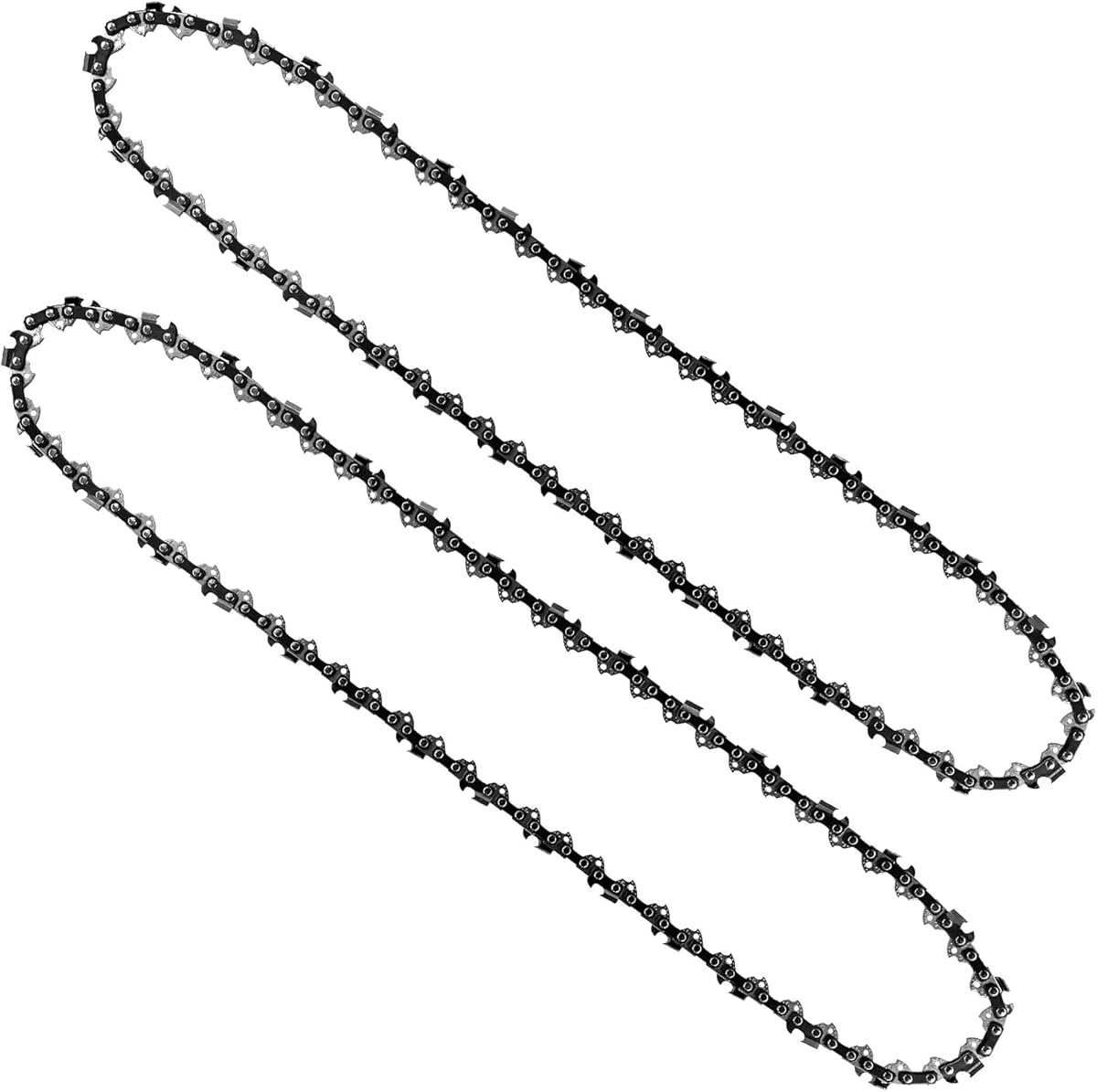
Start with the easiest measurement. Drive links are the small tabs on the bottom of the chain that point downward into the bar groove. They’re the most distinctive part of the chain — every other component (cutters, tie straps) sits on top.
To count them accurately:
- Remove the chain from the saw and lay it flat on a workbench
- Mark one drive link with a piece of tape, a marker, or a dab of correction fluid
- Count every drive link around the full loop, starting from your marked link
- Stop when you return to the mark
Write the number down. Common counts include 40, 44, 49, 52, 56, 57, 62, 66, 72, and 78, but your chain could be any number. Don’t round up or down — the count must be exact.
If the chain is broken, lay the pieces end to end and count all drive links across the fragments. As long as you have the complete chain (no missing sections), the total will be correct.
Step 2: Measure Pitch with a Ruler
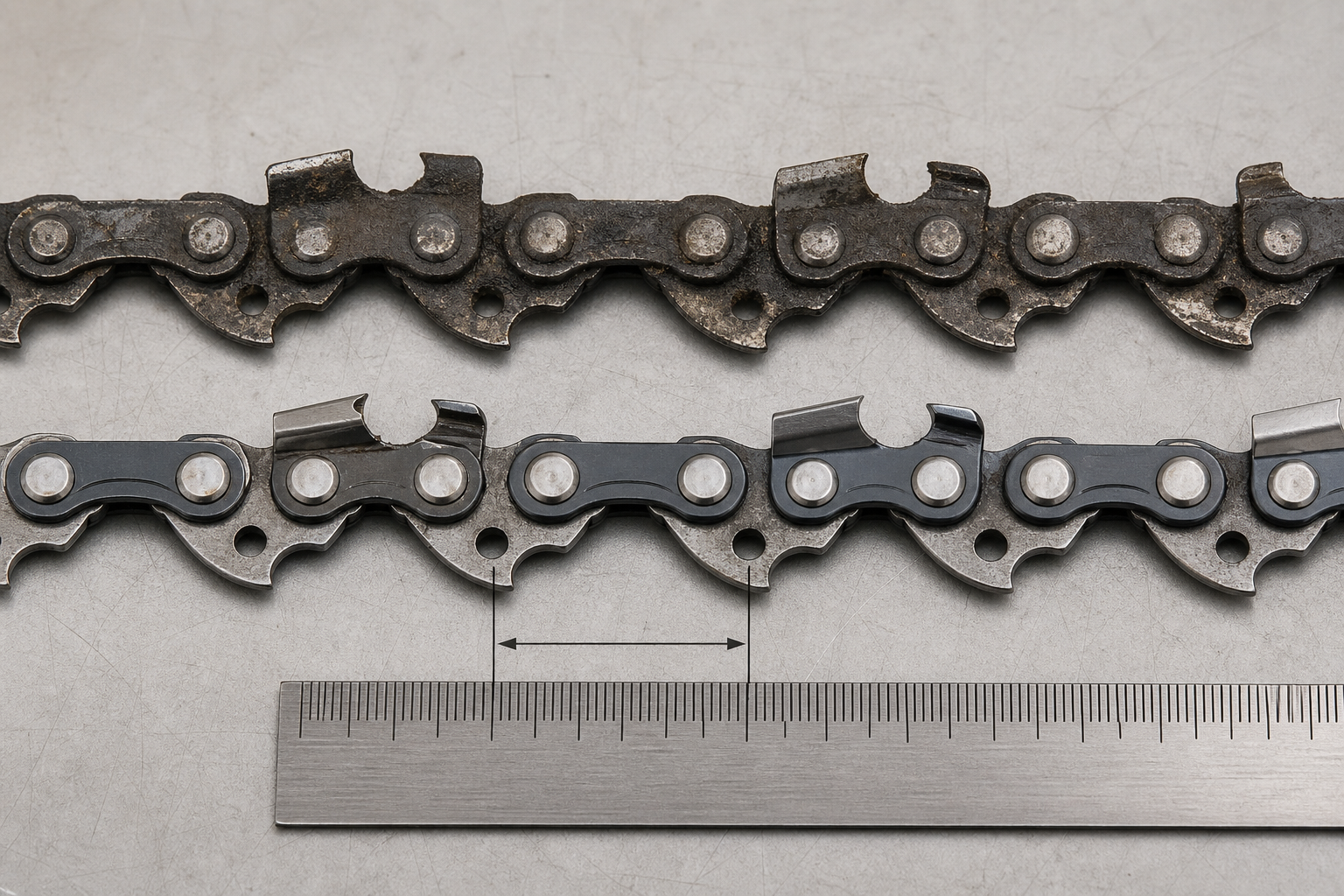
Pitch is the distance between the chain’s rivets, expressed as half the span of three consecutive rivets. You don’t need a special tool — a standard ruler or tape measure works fine.
Here’s the method:
- Lay the chain flat with the drive links pointing down
- Pick any three consecutive rivets — these are the round pins that hold the chain links together
- Measure the distance from the centre of the first rivet to the centre of the third rivet
- Divide that measurement by two
The result is the pitch. Here are the standard values you’ll land on:
| Measurement (3 rivets) | Divided by 2 | Pitch |
|---|---|---|
| 12.7 mm (1/2”) | 6.35 mm (1/4”) | 1/4” |
| 16.5 mm (0.649”) | 8.25 mm (0.325”) | 0.325” |
| 19.05 mm (3/4”) | 9.525 mm (3/8”) | 3/8” |
| 20.5 mm (0.808”) | 10.26 mm (0.404”) | 0.404” |
Your measurement won’t be exact to the decimal — worn chains have some play. Round to the nearest standard pitch. If you get something close to 9.5 mm, it’s 3/8”. If it’s closer to 8.3 mm, it’s 0.325”.
Important note on 3/8” Low Profile vs 3/8” full: Both have the same rivet spacing, but Low Profile chains have smaller cutters and thinner drive links. You can distinguish them visually — Low Profile chains look noticeably lighter and thinner. If your saw is a homeowner model with a bar 16” or shorter, it almost certainly uses 3/8” Low Profile. If it’s a larger professional saw, it’s more likely 3/8” full.
Step 3: Measure Gauge with a Coin or Calliper
Gauge is the thickness of the drive links — the part that slides into the bar groove. This is the trickiest spec to measure without a calliper, but there are practical workarounds.
With a calliper or micrometer
Measure the thickness of any drive link at its widest flat section. Standard gauges are:
- 0.043” (1.1 mm)
- 0.050” (1.3 mm)
- 0.058” (1.5 mm)
- 0.063” (1.6 mm)
With coins (a quick field method)
This won’t give you a precise reading, but it helps narrow the options:
- A UK 1p coin is approximately 1.52 mm thick — close to 0.058” gauge
- A UK 5p coin is approximately 1.7 mm thick — too thick for most gauges but useful as an upper reference
- A 10p coin is approximately 1.85 mm thick
Try sliding the drive link portion of the chain into the bar groove. If you still have the bar, that’s your best gauge reference. The drive link should fit snugly in the groove without being forced and without wobbling side to side. If it slides in easily with visible play, the chain may be a thinner gauge than the bar requires (or the bar groove is worn).
With the bar groove
If you have the bar but no chain specifications, you can check gauge by sliding different-gauge drive links or feeler gauges into the groove. Most replacement chain suppliers can identify the correct gauge if you provide the bar model number.
Step 4: Cross-Reference Part Numbers
Once you have all three measurements — drive-link count, pitch, and gauge — you can search for a replacement. But there’s one more shortcut worth trying: the old chain may have identifying marks stamped directly on the drive links.
Look for:
- Small numbers or letters stamped on the flat surface of the drive links
- Manufacturer logos — Oregon, Stihl, Husqvarna, and others stamp their chains
- Chain type codes — for example, Oregon uses numbering systems like 91PX, S62, or 73LPX that encode pitch, gauge, and chain profile
If you can identify the chain type code, you can look it up directly without measuring. Even a partial code narrows the search considerably.
Also check:
- The guide bar — even a partially legible bar stamp can confirm one or two specs
- The saw model number — manufacturers publish chain specifications for each model, usually available online
Step 5: Verify Before You Order
Before placing your order, do a final cross-check:
- Drive-link count: exact number, no rounding
- Pitch: confirmed by measurement or bar stamp
- Gauge: confirmed by measurement, bar groove, or bar stamp
- Bar length: measured from the front of the saw body to the bar tip (nominal length)
All four should agree with each other. If anything seems off — for example, you measured 3/8” pitch but the bar stamp says 0.325” — recheck your measurements. A one-spec mismatch means the chain won’t fit correctly.
When in doubt, measuring from the old chain is always more reliable than guessing from the saw brand or bar length alone. Two saws from the same manufacturer can use completely different chain setups if they have different bars fitted.
What to Look for in a Replacement
With your pitch, gauge, and drive-link count confirmed, look for an exact-match replacement chain that lists all three specifications clearly. If your bar is also worn, a bar-and-chain combo matched to your saw eliminates any risk of mismatched components. Quality replacement chains will have the specifications printed on the packaging and often stamped on the chain itself, so you can verify the match before fitting.

Find the right part on Amazon
Check price, stock and fitment — ships direct from Amazon.
§ Parts